
Free-Range Dogs and Missing Tags:
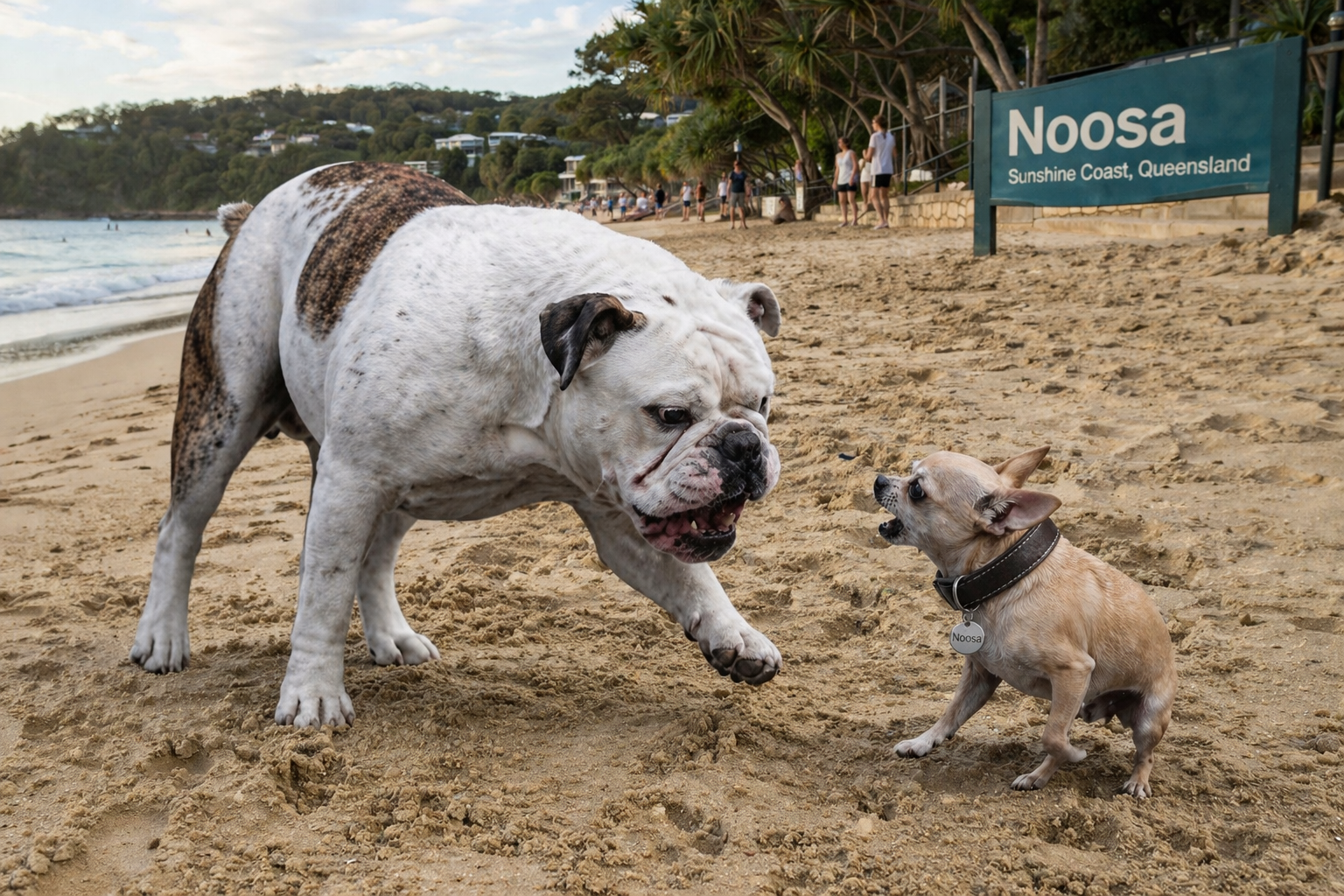
Bullying in action - No collar NO Tag
When “She’ll Be Right” Stops Being Funny
There is a particular kind of confidence on display in some neighbourhoods: the quiet certainty that rules and fees are for other people. It reveals itself in small ways - an unlatched gate, a dog wandering ahead of its owner, a collar conspicuously missing the one detail that matters. No tag. No registration. No way to tell who is responsible when things go wrong. To hear some owners tell it, registering a dog is an unnecessary chore - another form, another fee, another reminder that civic life requires participation. “He knows his way home,” they’ll say, as if that settles the matter. Others take a more philosophical approach: dogs should be free, paperwork is a nuisance, and the neighbourhood can sort itself out. Why are there fees in first place?
A dog without a tag is a dog without a clear line of accountability. When it bolts across a road, chases a cyclist, or corners another pet, the question isn’t just what happened - it’s who answers for it. Local residents describe a growing unease. Morning walks have become less routine, more tactical, with many feeling unsafe on local off leash beaches and in specifically designated parks. Parents keep a closer eye on children walking to school. Runners swap routes after a close call. The tone shifts from amusement to vigilance, from “someone’s dog is out again” to “what if next time it isn’t friendly?” There are even encounters in National Parks - where they are banned. The risks are not hypothetical. Unrestrained dogs are more likely to react to sudden movement - bikes, prams, joggers - without warning. Even well-natured animals can misread a situation. A startled dog can bite. A playful chase can become a collision. A moment’s inattention can escalate quickly, and without identification, the aftermath becomes harder for everyone involved. No tags no responsibility.
Then there is the dog itself. Without a tag, a lost animal becomes a mystery. A passerby who wants to help has no immediate way to return it home. Time stretches. Stress builds - for the animal, for whoever finds it, and eventually for the owner who discovers too late that “he always comes back” is not a guarantee.
Councils, for their part, have long treated registration and tagging as the baseline of responsible ownership. Not as bureaucracy for its own sake, but as a practical system: a way to reconnect lost pets, to track compliance, and to ensure there is a point of responsibility if something goes wrong. A system that costs money to administer.
Owners who do the right thing are reminded of that responsibility each year. Registered dog owners receive renewal notices - posted or emailed (whatever the dog owner chooses) prompting them to keep details current and fees paid. It is a routine process, predictable and clearly communicated.
By contrast, enforcement tends to arrive only after opportunities to comply have been ignored. Where a dog has been previously registered but renewal notices have gone unanswered, councils may escalate. Owners of dogs that remained unregistered - for 2 years - after failing to respond to prior years’ renewal notices have, in some cases, received infringement notices - formal penalties that signal the end of reminders and the beginning of consequences. Yet the existence of notices and fines is only part of the equation. Their effectiveness depends on whether people understand that they apply to them. Once referred to a collection agency and their driver’s license can be suspended - they usually comply but kick up almighty storms - that they are special.
What makes the current trend notable is not outright defiance, but a softer, more familiar attitude - casual non-compliance. A belief that skipping a step here or there carries no real consequence. That the community will absorb the risk. That someone else will deal with the fallout. They don't have to contribute financially at all, let others pay instead.
Responsible ownership is not complicated. A registered dog. A collar with current identification. Supervision in public spaces. These are not onerous demands; they are the minimum required to ensure that freedom - for the animal and the owner - does not come at someone else’s expense. There is, of course, a certain Australian instinct to downplay fuss. To prefer common sense over rules. In many areas of life, that instinct serves us well. But with animals capable of causing harm, clarity matters more than optimism.
A dog without a tag might feel like a small thing. In practice, it is the difference between a situation that can be resolved in minutes and one that spirals into uncertainty. Between a community that trusts its neighbours and one that watches a little more carefully over its shoulder.
At some point, “she’ll be right” stops being a philosophy and starts being a gamble. And it is rarely the person placing the bet who pays the full cost or the dogs bitten in attacks - suffering either death or expensive to fix injuries, with no identification of animal available - as required under law.