
PROCESS BECOMES THE PRODUCT
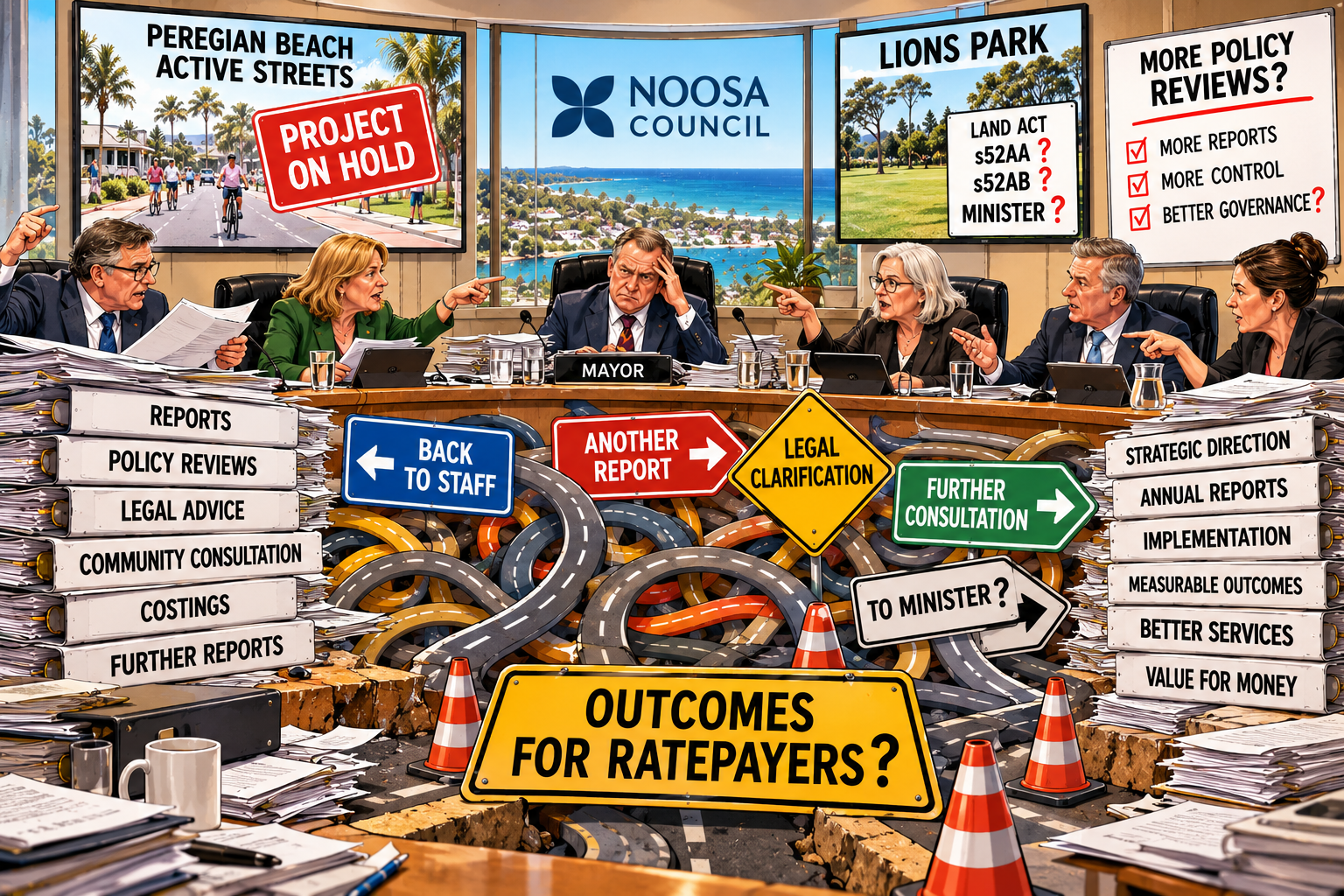
WHAT ARE RATEPAYERS PAYING FOR?
Endless reports,
endless reviews,
endless political intervention.
But where are the outcomes ratepayers are paying for?
NOOSA — The ultimate test of a council is not how many reports it produces, how many policies it revisits or how many meetings it holds.
It is whether ratepayers get better decisions, better services and better value for money.
At Noosa Council, a Cr recently acknowledged that councillors spend too much time dealing with operational matters rather than strategic policy. The proposed solution? Bring more policies back to Council to give elected representatives greater control over policy direction.
There is a contradiction here.
If excessive intervention in operations is the problem, will more policy reviews solve it - or simply create another avenue for political involvement in administration?
Clear policies enable staff to deliver results. Endless reviews risk keeping them occupied preparing reports instead. The number of reports produced is not a measure of good governance.
The outcomes they deliver are.
PEREGIAN: WHEN PROJECTS HIT THE BRAKES
The Peregian Beach Active Streets project illustrates the consequences of contested decisions and changing direction.
There can be legitimate reasons to halt or redesign a project. But residents deserve answers: what did the additional scrutiny achieve, what were the costs of delay, and what happens next?
Stopping a project is not automatically bad governance. Failing to explain the consequences and deliver a clear alternative is a different matter.
Ratepayers fund infrastructure, not an endless administrative obstacle course.
What is happening to the government grants now?
LIONS PARK:
The Lions Park debate raises an equally important question about process.
Section 52AA of Queensland’s Land Act 1994 provides a pathway for ministerial approval for certain actions inconsistent with the purpose of trust land, subject to statutory requirements, for Trustees other than Council.
Section 52AB provides a separate management-plan pathway in relevant circumstances for Council.
Seeking clarification of the law is legitimate. If the original advice was sound, given the distinction between who is applying already existed - why was so much time spent questioning it?
Turning recreational parkland into a parking lot when Noosa is Different by Nature and protects its natural environment is a supreme contradiction.
Also adding to confusion in the Community.
THE REAL COST OF ENDLESS REPORTS
Every additional report consumes staff time. Every deferral can delay decisions. Every review competes with other priorities.
Some reports are essential. Others may prevent costly mistakes. The test is whether their public benefit justifies their cost.
Councillors should set strategic direction, scrutinise performance and hold the administration accountable. Professional staff should provide independent advice and implement lawful decisions within their authority.
If policies are too slow, establish a review schedule. If performance is inadequate, demand results. If a legal question arises, resolve it and move forward.
Don’t turn every disagreement into another layer of process.
THE ULTIMATE TEST
Noosa residents want functioning infrastructure, protected public spaces, efficient services and responsible spending.
They deserve to know whether additional reports and reviews are producing better decisions - or simply more paperwork.
Good governance is not the production of reports. It is the delivery of results.
If the process improves outcomes, demonstrate it.
If it does not, change it.
Because Noosa Council exists to serve its residents, not to keep its own machinery permanently occupied.
Ratepayers should not have to pay for the process to become more important than the purpose.