
FOUNDING VISIONARIES WERE APPARENTLY TERRIBLE ACCOUNTANTS
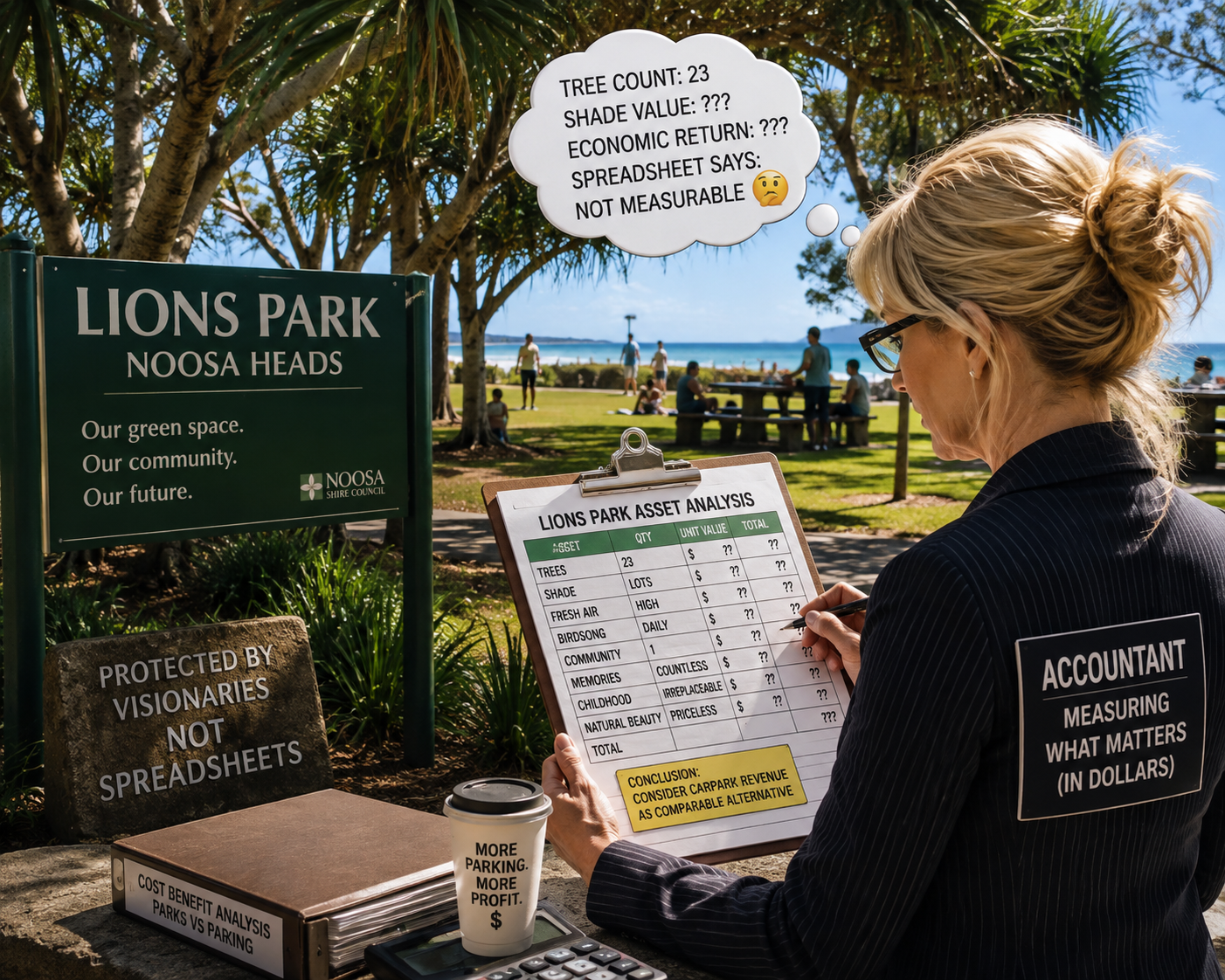
NOT HOW NOOSA WAS CREATED
Noosa’s long-standing reputation as a place protected by generations of people who apparently understood that forests, beaches, waterways and green spaces were worth more than their immediate commercial return has come under fresh scrutiny this week.
The controversy follows the discovery that some of Noosa’s most important environmental decisions were made by people who, in a shocking departure from modern governance principles, did not first ask how much money could be made from the land. Historical visionaries who fought to protect Noosa’s natural environment are now understood to have committed the extraordinary error of looking beyond the next spreadsheet.
Instead of asking whether a piece of land could generate additional parking revenue, increase turnover or improve short-term economic activity, they apparently asked questions such as:
“What do we want Noosa to look like in 50 years?”
Authorities are understood to be investigating how this reckless behaviour was allowed to continue.
THE PROBLEM WITH VISIONARIES
The people who helped establish Noosa’s environmental legacy and world class tourist economy - apparently believed that once green space was gone, it was gone. They also held the quaint view that Council’s job was not necessarily to monetise every available square metre.
This philosophy resulted in things now regarded as increasingly suspicious in modern public administration, including national parks, protected bushland, open space and public areas that exist primarily because they are pleasant places for human beings to enjoy. They made decisions based on what Noosa should become, rather than what would produce the best quarterly spreadsheet.
70% OF COMMUNITY APPARENTLY FAILED ACCOUNTING TEST
When more than 70 per cent of respondents in DMP consultation indicated they want green spaces such as Lions Park protected from car parking. However, this overwhelming community preference has apparently encountered a technical difficulty. It cannot easily be entered into an Excel spreadsheet under the heading “Economic Return Per Square Metre.”
Accountants say this creates a serious problem.
Because while residents may value shade trees, open space, recreation, amenity, environmental protection and the character of Noosa, these things are notoriously difficult to calculate - the knowledge that your children and grandchildren will inherit a park rather than another expanse of asphalt seems irrelevant.
ONE ACCOUNTANT ASKS WHETHER THE FOUNDERS GOT IT WRONG
An unnamed accountant has reportedly suggested that before any decision is made about Lions Park, Council should first obtain sufficiently robust traffic counts, pedestrian counts, congestion modelling, economic modelling and comparative data. The proposal has caused considerable excitement among those who believe that the correct way to decide whether a park should remain a park is to first establish the precise dollar value of people sitting under trees.
The approach has also raised questions about Noosa’s historical decision-making.
If every decision had required a comprehensive economic model, locals wonder whether some of Noosa’s most treasured environmental protections would ever have happened. Perhaps the visionaries should have commissioned a business case first.
Perhaps the national park needed a five-year KPI framework. Perhaps the trees should have demonstrated measurable economic productivity. Perhaps someone should have asked whether preserving Noosa’s environment represented an acceptable return on investment.
Fortunately, they didn’t.
They just protected it.
THE RADICAL IDEA THAT SOME THINGS ARE WORTH MORE THAN MONEY
This is where the current debate becomes particularly awkward. Because Noosa was not created as a successful destination by people who thought:
“How can we maximise the financial yield from every piece of land?”
It became Noosa because generations of people understood that its greatest competitive advantage was precisely the thing that could be destroyed by overdevelopment:
its environment. The forests, beaches, waterways, open spaces and village character weren’t obstacles to Noosa’s success. They were the reason for it.
And that presents an inconvenient lesson for anyone - especially someone brought up overseas - attempting to evaluate every public asset exclusively through an economic lens against our intrinsic Aussie value system.
Sometimes the most financially valuable thing a community owns is the thing it deliberately chooses not to monetise.
NOOSA’S NEW VISION
Under the emerging philosophy, residents may soon be asked to reconsider the original vision for Noosa.
Instead of:
“Protect what makes Noosa special.”
The new slogan could be:
“Justify what makes Noosa special in dollars.”
Because apparently a community’s 70 per cent vote to protect a green space isn’t enough. The park needs a business case. And somewhere, presumably, a spreadsheet is being prepared to calculate the financial value of the birds.
THE REAL COST
The irony, of course, is that once environmental assets are destroyed, no amount of subsequent modelling can recreate them. You can build another car park. You can repaint lines. You can install signs. You can collect parking revenue.
But you cannot simply purchase back the environmental character that made Noosa valuable in the first place. The people who protected Noosa understood something that doesn’t appear on a balance sheet:
Some assets are most valuable precisely because you refuse to exploit them. Which leaves Noosa with a rather uncomfortable choice. It can follow the example of the visionaries who protected the place for future generations.
Or it can become very good at calculating the economic value of the things their predecessors had the good sense not to sell.