
Noosa Tourism
NOOSA - A new analysis has uncovered a serious threat to Noosa’s tourism industry: the environmental protections that helped make Noosa famous.
After years of protecting beaches, national parks, waterways, forests, wildlife habitat and the distinctive character of the Shire, the environment has apparently become dangerously influential.
The problem, according to a recent analysis by a likely Mayoral candidate for 2028 (failed 2024) - of the proposed Noosa Destination Stewardship Council, is that the environmental philosophy embedded in Noosa’s Destination Management Plan may have become so powerful that tourism is now expected to operate within the very environment that attracts the tourists. Would such an anti-environment Mayor work for Noosa? One reportedly involved as Investor in a failed attempt at a major housing development in the Hinterland?
This has raised the obvious question:
What exactly did everyone think tourists were coming for?
THE ENVIRONMENT HAS BEEN ACCUSED OF CREATING TOURISM
For decades, Noosa has marketed its natural beauty as one of its greatest assets.
Visitors come for the beaches, national parks, Noosa River, coastal landscape, forests, wildlife, clean waterways and village character with relaxed vibe.
The absence of the kind of development that turned many other coastal destinations into indistinguishable concreted strips of high rise apartments, multi storey car parks and traffic lights. ignoring the future when cars will be dropping off in designated areas from various sites located inland using Driverless cars. No need for car parks to increase.
And now, apparently, the environmental protections that helped preserve all of that are being treated as though they are somehow standing in the way of the economy and tourism. Noosa has spent decades protecting the product and is now being asked whether protecting the product is anti-business.
THE GREAT TOURISM PARADOX
The analysis argues that the DMP is “conservationist” because it places environmental protection at the centre of destination management. But there is a small problem with this argument. Noosa’s environment isn’t separate from its tourism industry. It is the tourism industry’s principal attraction.
The rainforest - beach - national park - the Biosphere are not competing with tourism.
The very things being protected are the reason people book the accommodation, eat in the restaurants, visit Hastings Street, attend events, hire boats, surf, walk, cycle and spend money throughout the Shire.
In other words, Noosa may have accidentally discovered the world’s most unusual business model:
Protect the Product, and then complain that protecting the product is restricting sales.
THE 80% PROBLEM
There is another inconvenient piece of Noosa history. THE FACTS:
When Noosa residents were asked in 2013 whether Noosa should leave the Sunshine Coast Regional Council and regain its own council, more than 80% of formal votes supported de-amalgamation.
And in 2007, an EXTRAORDINARY 96% voted against amalgamation in the earlier poll. Those votes were not technically referendums on environmental protection.
But they demonstrate something rather important about the Noosa community:
Local control and protection of Noosa’s distinctive character have deep roots.
Which makes the suggestion that environmental stewardship is simply an ideological project imposed by a small conservation lobby (the much maligned NPA) - somewhat difficult to reconcile with Noosa’s history.
THE TERRIBLE THREAT OF REGENERATIVE TOURISM
The DMP uses the phrase “regenerative tourism.”
This apparently constitutes evidence that the environment has won the argument.
Except that regenerative tourism essentially asks whether tourism can leave the destination stronger rather than simply consuming what is already there. Which seems particularly radical in a place whose entire tourism proposition depends upon remaining attractive.
The alternative appears to be the more traditional tourism philosophy: Turn up, consume the asset, increase the volume, and then appoint a committee to investigate why the asset isn’t quite as attractive anymore.
THE MYSTERY OF THE MISSING TOURISTS
There is also a curious omission in the argument about environmental protection.
Where exactly are all these tourists supposedly wanting to go?
Are they arriving in Noosa hoping to see:
a bigger concrete footprint?
more traffic?
more high-rise?
fewer trees?
less wildlife?
degraded waterways?
more development along the coast?
Or are they coming because Noosa didn’t become that place?
That is the uncomfortable economic reality.
Environmental protection isn’t merely a cost imposed on Noosa’s tourism industry. It is one of the reasons the industry exists.
THE BIOSPHERE HAS ENTERED THE BOARDROOM
The proposed Destination Stewardship Council will include environmental, community, tourism, business, government and First Nations representation.
This has nevertheless prompted concerns about the possibility of environmental interests becoming too influential.
Apparently one of the world’s most successful environmental tourism destinations now needs protection from its own environmental credentials. The logical next step may be to create a Tourism Protection Council whose first responsibility is to ensure that tourism is adequately protected from the beaches, forests, national parks and waterways upon which it depends.
THE RADICAL IDEA OF MEASURING EVERYTHING
There is, however, one genuinely useful idea emerging from the debate:
Measure the outcomes.
Measure the economy.
Measure community wellbeing.
Measure visitor numbers and behaviour.
Measure environmental condition.
Measure congestion.
Measure the impacts of tourism.
Measure whether the benefits actually flow into the local economy.
And publish the results.
Because the real question isn’t whether Noosa should choose the environment over the economy.
It is whether Noosa can maintain an economy because it has protected the environment that created the economy in the first place.
NOOSA’S SECRET BUSINESS PLAN
For decades, Noosa has effectively followed a remarkably simple strategy:
Protect what makes Noosa special.
The strategy produced an extraordinary natural asset. The natural asset attracted visitors.
The visitors created businesses. The businesses created jobs.
The jobs supported the local economy.
And the destination became one of Australia’s best-known tourism locations.
Now the debate has somehow reached the ludicrous point where protecting the thing that started the process is being described as a threat to the process.
Perhaps the next destination management strategy should begin with a radical proposition:
The environment isn’t the competitor to Noosa tourism.
The environment is Noosa tourism.
And if the industry wants to keep selling the product, perhaps the first rule of the business plan should be:
Don’t destroy the product.
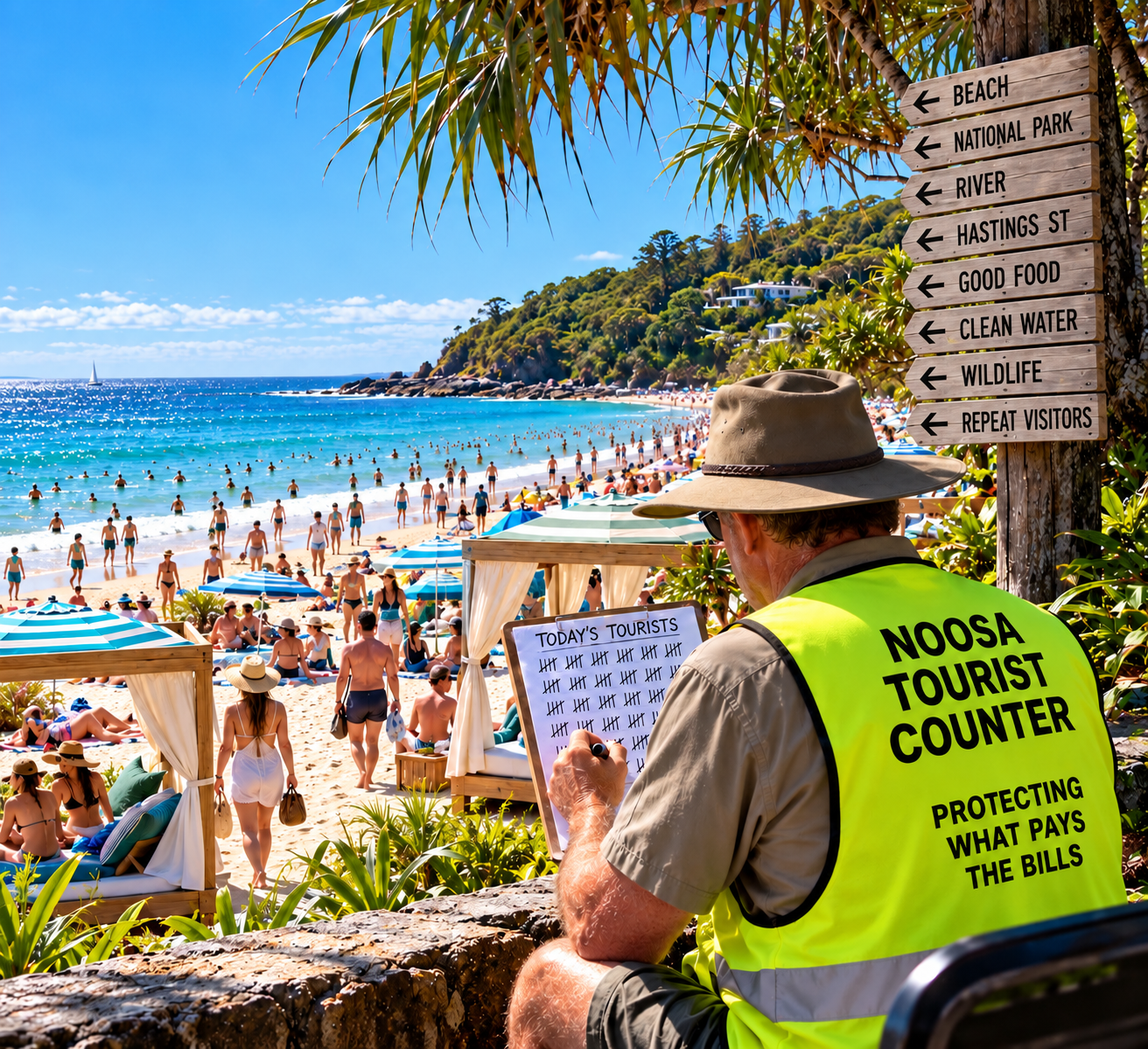
IS THIS MEASURING THE ECONOMY?