
LOCAL KEYBOARD WARRIORS DECLARE WAR ON REALITY & STATE LAW
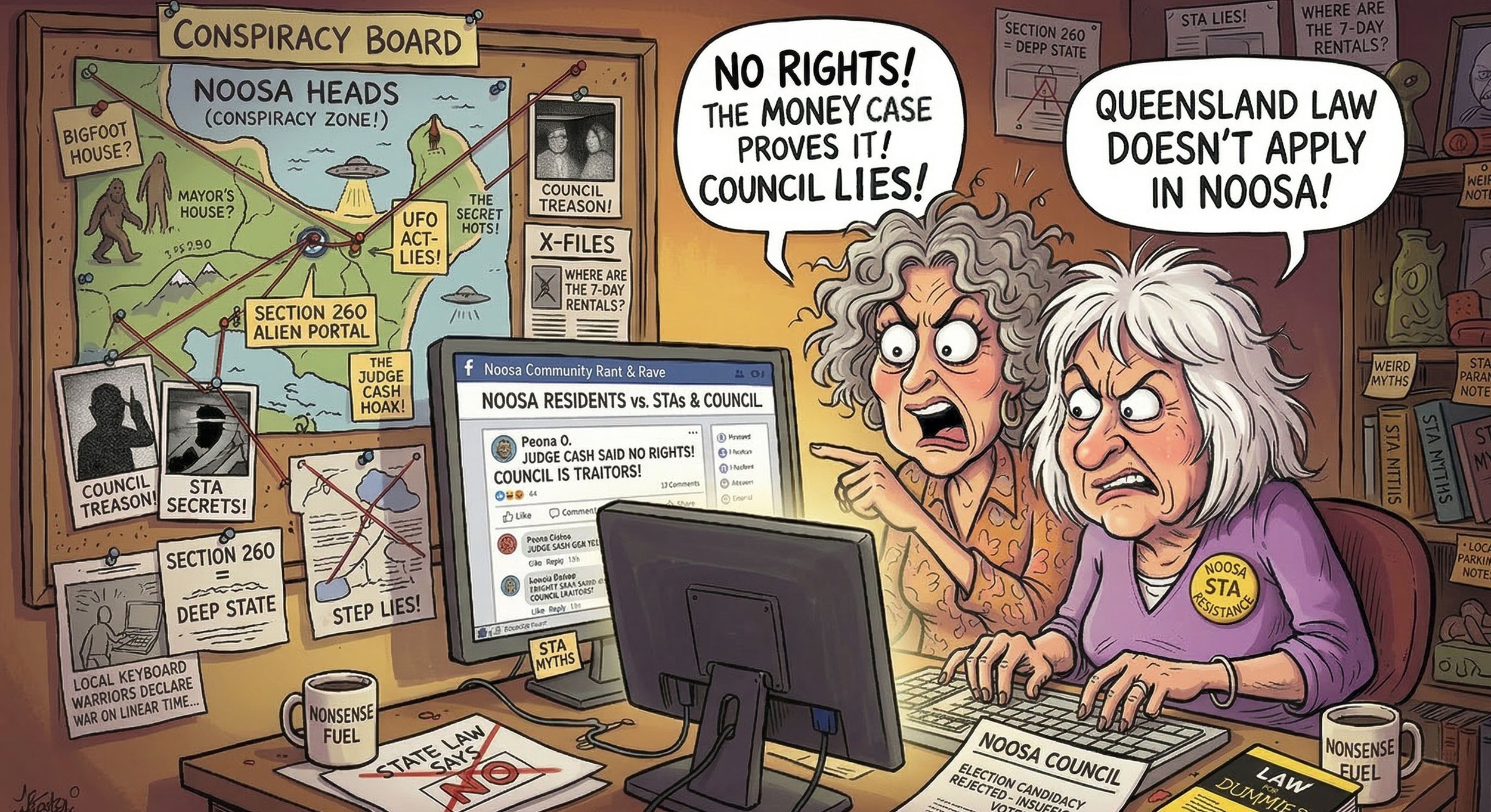
In the digital trenches of Noosa’s more toxic Facebook groups, a relentless insurgency is being waged by a small group of misguided operatives. Armed with unlimited data plans and a spectacular immunity to statutory reality, they have made it their life’s work to hold Noosa Council accountable for “crimes" it hasn't committed, under laws they fundamentally seem to misunderstand, regarding a nostalgia that never legally existed.
Their daily target is the supposed scourge of Short-Term Accommodation (STA) like AirBnB in Noosa. For some reason, these activists refuse to acknowledge that any property used for holiday-letting between the broad, unrestricted days of the Noosa Plan 2006 and the more restrictive Noosa Plan 2020 is legally protected by State Law. Provided there is proof of historical letting records, these entirely legal property uses are locked-in. The very term “STA" didn't even exist back then.
Deep down, in their quiet moments between frantic keystrokes, these activists likely realise that Section 260 of the Planning Act 2016 acts as an impenetrable, grandfathered forcefield for owners who meet the strict historical holiday-letting criteria. A core tenet of their daily outrage is the endless, repetitive demand to see a property’s “Material Change of Use" (MCU) development approval. While modern planning schemes do dictate that new tourist accommodations require an MCU, they intentionally ignore that Section 260 explicitly exempts grandfathered properties from this requirement. Demanding an MCU for a pre-2020 historically let holiday home in Noosa is legally akin to demanding a pilot's license for a pushbike. However, admitting that State legislation legally paralyses local Council likely doesn't garner enough sympathetic outrage online. To maintain the campaign, it seems the numbers of those opposing reality and the law must be increased at any cost!
These misguided keyboard warriors refuse to acknowledge that Noosa was built on short-term tourism over many decades; making it the highly desirable place they eventually decided to live in, with many great restaurants, facilities and protected habitats they enjoy thanks to tourism dollars. In all small beach hamlets, the primary source of such tourist accommodation remains privately owned holiday houses. In Noosa, these were never regulated under the 2006 plan and these private houses still function as normal standalone homes; the only difference is that since 2020 they have been formally registered as STAs and pay double the Council rates. This creates a revenue bonus that never existed before, allowing other Noosa Shire residents to save on their own rates and enjoy better services. Furthermore, any owners not complying with local laws remain subject to fines.
But facts don’t matter to our heroes it seems. To hear them tell it, the Council is a cabal of lazy bureaucrats simply refusing to press a big red “Cancel Existing Legal Rights" button supposedly hidden under the Head Planner’s desk. When exhausted legal professionals remind them that local Council cannot override State Law to retrospectively ban historically acceptable uses, they typically respond with capitalised words and vague references to the “vibe" of 2006. They often claim holidays “back then” lasted a mandatory seven days, despite the Noosa Plan 2006 containing no words to that effect and most people having sufficient memory of 20 years ago to know that is simply not true.
Instead, these dedicated keyboard warriors prefer to interpret the law through a quasi legally warped lens, having no legal training. The crowning jewel of their argument is the triumphant, breathless citation of rulings by a single Judge. “The Judge has spoken! No rights exist!" they declare loudly to their echo chamber, attaching out-of-context paragraphs with the fervor of conspiracy theorists unearthing a blurry photo of Bigfoot. They conveniently omit the context and the hilarious factual reality of the specific ruling upon which they rely: That the applicants of that case didn't lose STA approval because pre-2020 STA rights were generally unlawful; they lost because their own formal letting history consisted entirely of allowing a sister-in-law to crash in the guest room for free over Christmas!
Despite the absurdity of comparing a free family sleepover to a formalised holiday rental booking ledger, this specific case is held up as ultimate proof of Council's “treason". These online activists claim existing use rights don't exist, based on one case that has no bearing on actual pre-existing legal holiday rentals.
Yet no local conspiracy theory is complete without a totally irrelevant, out-of-town comparison. Online sleuths frequently point down the Bruce Highway, triumphantly declaring that because Brisbane City Council “cracked down" on AirBnBs, that Noosa Council simply lacks the political backbone to do the same. This spectacular misfire ignores the tedious reality of statutory law: Brisbane and Noosa operated under entirely different historical planning schemes - even though Brisbane is now copying Noosa because it was first to bring in these STA controls,
UPDATE:
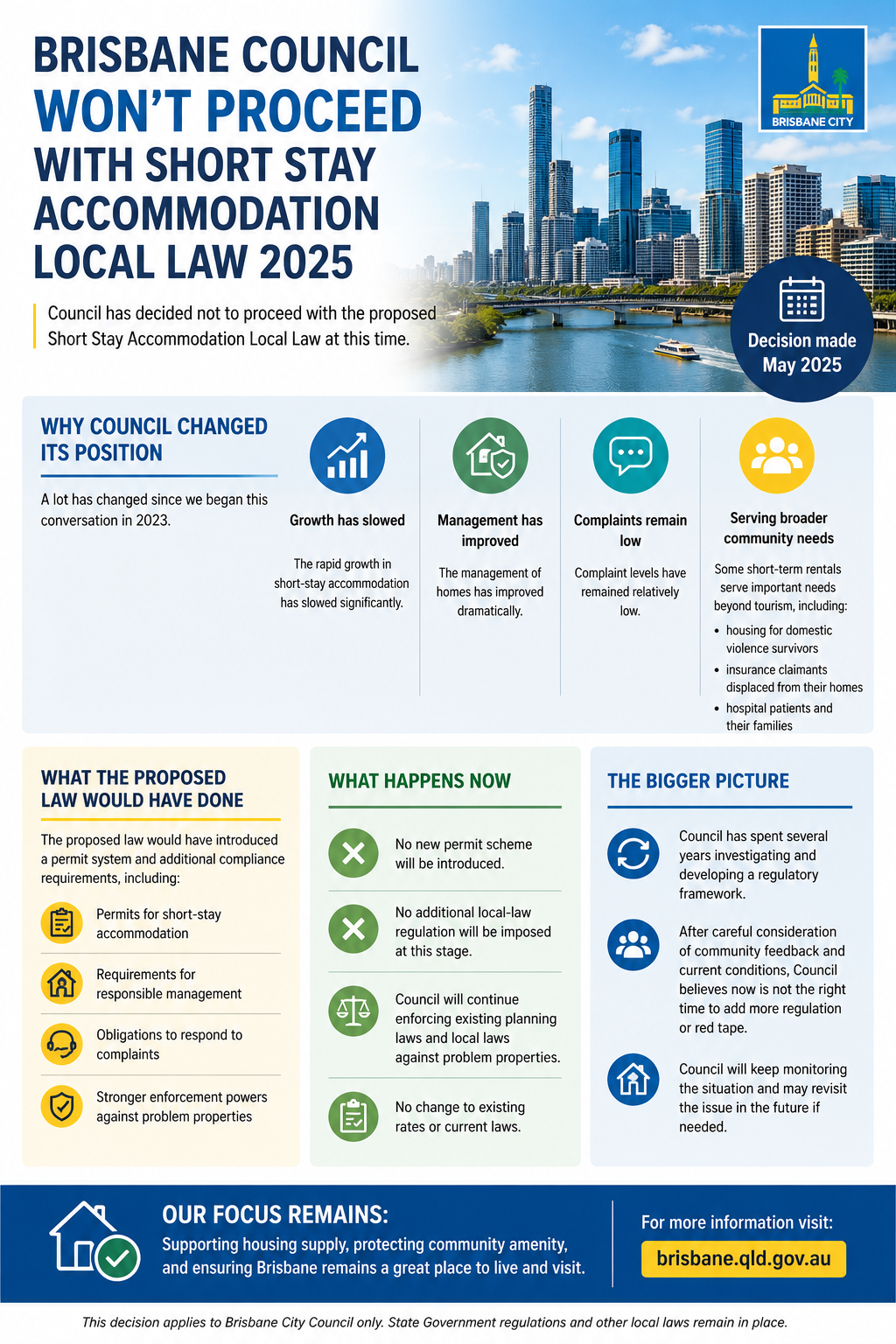
When Brisbane shut down some short-term rentals, (NOTE: BRISBANE IS NOT PROCEEDING WTH PROPOSED STA PERMIT SYSTEM) they weren't staging a localised rebellion against State legislation; they were simply prosecuting property owners who were operating unlawfully from day one. Because those Brisbane operators broke their specific local rules from the start, Section 260 of the State Planning Act offered them absolutely zero protection. You cannot grandfather a legal right you never possessed.
Noosa, however, is a completely different statutory beast. Under the broad, permissive days of the Noosa Plan 2006, short-term letting was validly established without those restrictive hurdles. Because those Noosa properties operated lawfully before the restrictive 2020 Plan kicked in, they are permanently shielded by the State's existing use rights.
So Brisbane didn't magically defeat Queensland planning law; they just enforced a different set of historical rules against people who broke them. Demanding Noosa Council “do what Brisbane did" is like demanding Noosa National Park rangers arrest a Bush Turkey because a bin chicken in Fortitude Valley stole a kebab.
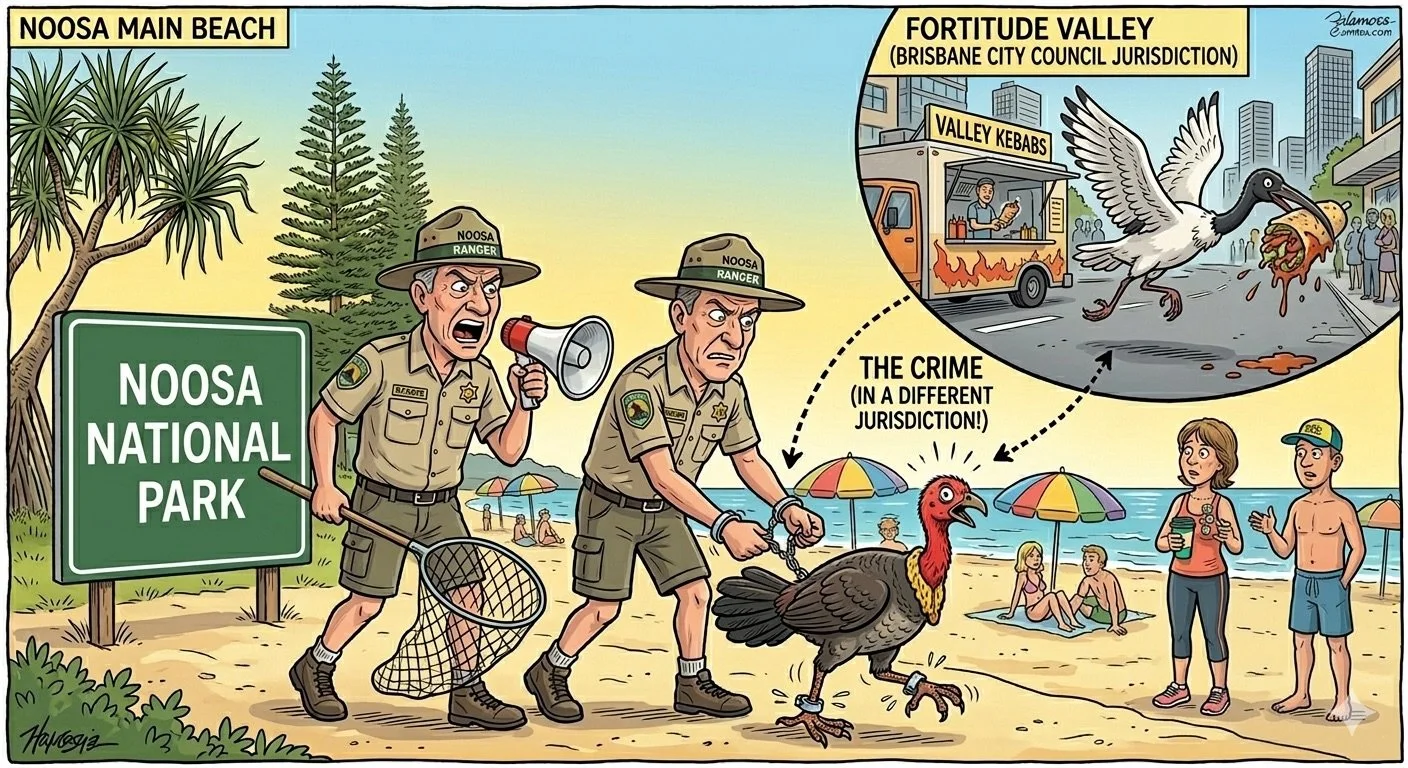
Wrong jurisdiction, wrong bird, right absurdity.
When their demands on Facebook groups to revoke the rights of lawful short-term accomodation properties inevitably hits the brick wall of Section 260, these keyboard warriors unveil their grand strategic masterstroke: demanding Noosa Council simply sue the Queensland State Government. They genuinely expect local planners to launch a multi-million-dollar legal crusade against the state to retroactively ban families who have been legally holiday-letting their beach houses for decades. It is a legally illiterate fantasy.
The fact is that under the Australian system, local councils are essentially sub-committees of the State Government, entirely subordinate to state legislation. They do not possess the sovereign authority to veto the Planning Act 2016, nor can they successfully sue the State for the “crime" of drafting the very laws the Council is explicitly mandated to enforce. Demanding that Noosa Council drag the QLD State Government to court over grandfathered property rights is akin to a local Commonwealth Bank branch manager suing the Reserve Bank to dictate the national interest rate. It’s an exercise in supreme futility that would achieve nothing but the incineration of millions in ratepayer funds on a guaranteed, humiliating defeat.
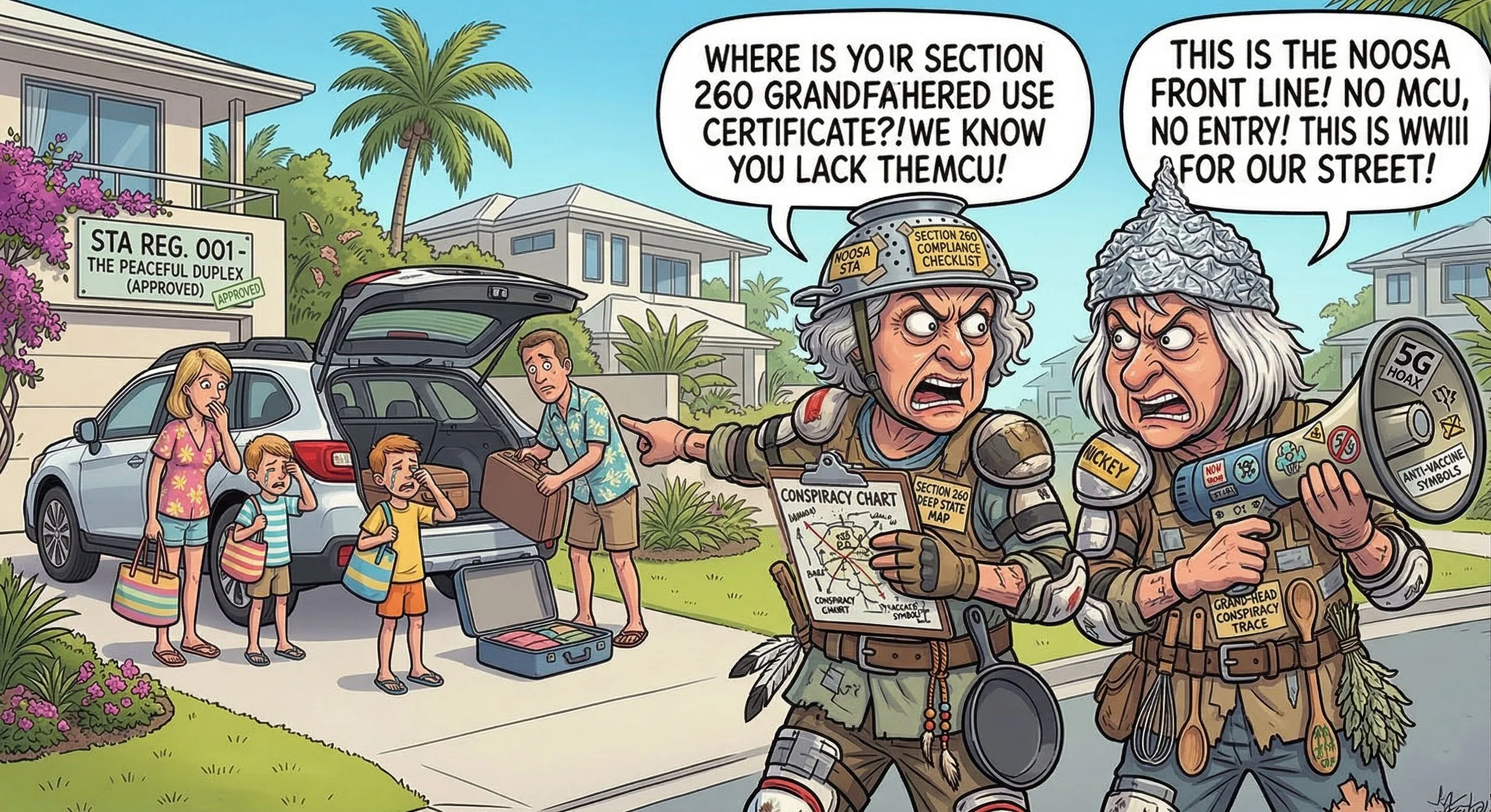
Noosa Operatives Demanding Material Change of Use (MCU) Papers
But if you were to rely solely on the digital theatrics and online noise generated by these keyboard warriors, you would be forgiven for assuming Noosa Heads was enduring a catastrophic, pandemic-level siege of rogue holidaymakers.
According to their mashed typings, every residential street has been transformed into a dystopian wasteland of non-stop raves, mis-parked jet skis and overflowing wheelie bins.
However, Noosa Council's actual compliance data from their August 2025 Planning & Environment Committee meeting review paints a contrasting and mundane picture of this “STA Apocalypse”. The 24/7 STA Hotline - the very frontline of this imagined war - reveals that a staggering 87% of approved STA properties have never received a single complaint. Of the calls that actually are made, 96% are minor and resolved within the required 30-minute window. The supposed “systemic collapse of residential amenity” is, in reality, isolated to just 3% of properties that have generated three or more complaints (and it’s highly probable that some of these repeat complaints originate from these very same keyboard warriors).
Rather than an insurmountable crisis, the statistics show a functional, highly regulated local law operating exactly as intended. While the online resistance roleplays as freedom fighters in the trenches of an apocalypse, the Council's short-stay team is quietly enforcing 386 compliance notices and 169 infringements against the actual minority of rule-breakers out of a shire with over 28,000 dwellings. For the activists, the greatest tragedy isn't the failure of the law; it's the statistical proof that their neighborhood is overwhelmingly peaceful.
Council planners, meanwhile, remain trapped in a bureaucratic purgatory. They are legally obligated by the State to approve genuine existing use applications while simultaneously being roasted online by a few keyboard warriors who refuse to accept that Queensland legislation outranks unqualified opinions on Facebook.
And so, the digital crusade continues. These warriors remain steadfast at their keyboards, fighting an entirely futile war against the immovable object of Queensland planning law, forever dreaming of a retroactive utopia that exists nowhere but in their own minds.