
The Reality Beneath the Tyres
Cooloola Beach
Why is beach driving controversial in this area?
Last year, authorities reduced the speed limits on some stretches of sand in a bid to ensure safety of both beachgoers and four-wheel drivers.
Gympie Regional Council announced a 14km section of Cooloola Beach, adjacent to the Teewah Beach camping area, had been reduced to 40 kilometres per hour. From a distance, the long stretch of sand along Teewah Beach looks like freedom - wide open sunlit. Tyre tracks stretch across like highways, engines hum where waves should be the loudest thing.
But this was never a road. This place — stretching through Cooloola Recreation Area brushing the edges of Great Sandy National Park - is protected land. A national park. A fragile system of dunes, tides, and nesting grounds older than any vehicle that now crosses it. Driving here isn’t a right. It’s a permit. And lately, it’s been treated like neither.
The Easter Long Weekend:
Over four days, nearly a hundred fines. Then more. In total, over 120 infringements across beaches people still call “getaways.” Police weren’t surprised. They had warned everyone.
Speeding.
Drink driving.
Drug driving.
No seatbelts.
Distraction.
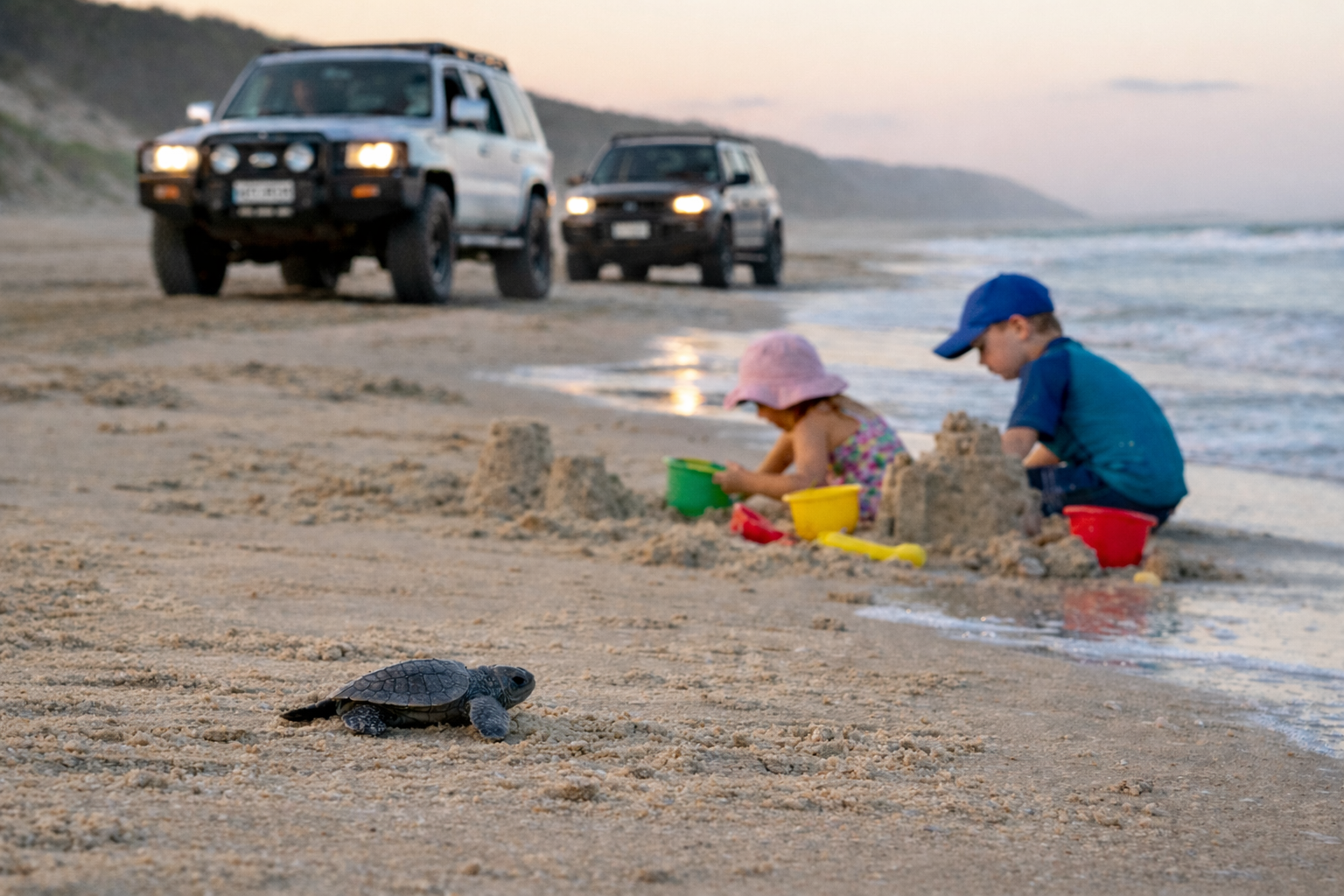
The “fatal five” - not on highways, but on sand. Police stopped cars where children were playing metres away. Breath-tested drivers beside tents pitched in what is, technically, a conservation zone. Issued fines where turtles would soon return to lay eggs. This wasn’t enforcement out of nowhere. It was response.
To drive on these beaches, you need a permit. Not as a formality - but as an agreement.
An agreement that says:
• You understand this is not a road
• You accept shared space with wildlife and people
• You drive to conditions, with no sense of Entitlement
• You leave no trace that outlasts the tide
But something shifts when enough people arrive in high spirits mixed with alcohol and a sense of freedom. Tracks become lanes that turn into Habits - that become assumptions and rights. Under the sand is life most drivers never see. Endangered green turtle nesting grounds. Shorebirds that vanish when engines approach. Dune systems that take decades to stabilise - and seconds to damage. The beach looks resilient. It resets with every tide, but not everything does. Bad Behaviour is forcing more change. Authorities have already started tightening control. Speed limits reduced, as mentioned now 40km/h along sections of Cooloola Beach. More patrols. More checks. And still, the number of offences climb. Not because people don’t know the rules - but because enough choose to ignore them. At what point does this privilege become unsustainable? Because this isn’t just about fines.
In the end it’s about whether a National Park can function as both a protected ecosystem and an informal roadway for hundreds of vehicles whenever the holidays arrive.