
Councillor Makes Budget Vote Conditional On Future Discovery Of Whatever It Is She Thinks Is Wrong
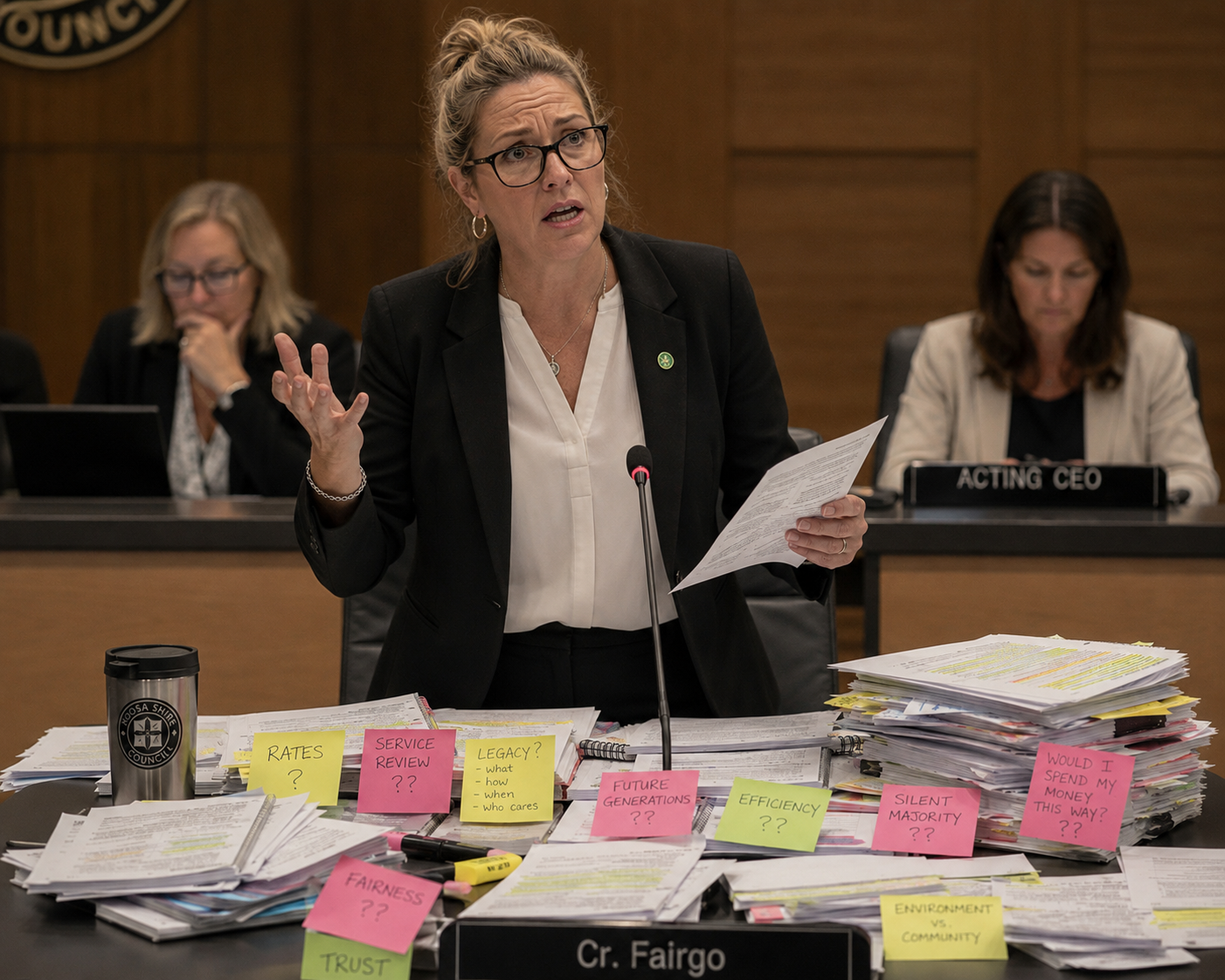
“THE SILENT MAJORITY SPEAKS! - Through One Councillor”
Local residents were left inspired, confused and mildly concerned yesterday after Councillor Sandra Fairgo announced that her support for the annual budget was conditional upon Council first conducting a comprehensive review to determine whether there was anything worth reviewing. Speaking for approximately the length of a feature film, Cr Fairgo explained that she had spent months agonising over the budget before arriving at the courageous conclusion that somebody should probably look into something.
“If we’re asking ratepayers to tighten their belts,” she said, “then Council must also tighten its belt. Which belt? How much tighter? That’s exactly the sort of question the review will review.”
The councillor revealed that her position had been strengthened after a chance encounter with a local business owner who recently laid off a staff member. While acknowledging that the business owner specifically told her the decision had nothing to do with Council rates, Cr Fairgo said she nevertheless regarded the conversation as compelling evidence that Council should examine itself. Attendees began to suspect they were witnessing a philosophical TED Talk rather than a budget debate when the councillor spent several minutes discussing legacy, fairness, trust, silence, responsibility, borrowed trust, future generations, sporting facilities, toilets and the metaphysical significance of chairs. At one point she reminded colleagues that elected representatives are merely “warming chairs for four years.”
Several ratepayers later confirmed this was the first time they had learned councillors were not, in fact, permanently attached to the furniture.
The centrepiece of the speech was a call for a full organisational review based on the possibility that Council might be inefficient.
Asked whether any evidence of widespread inefficiency had been identified, the councillor clarified that discovering inefficiency was the entire purpose of the review. “It’s impossible to say whether waste exists until we investigate it,” she explained.
“So you’re saying there may not be waste?” “Exactly. Which is why we urgently need a review.”
Political analysts described the argument as “beautifully circular.” “If the review finds waste, the review was justified,” explained one observer.
“And if it doesn’t find waste, then at least we’ll know there wasn’t any. It’s a rare argument that can never be disproved.”
The speech concluded with a solemn warning that future generations would inherit the consequences of today’s decisions, though nobody was entirely certain whether this referred to budget settings, ageing infrastructure, environmental policy, or the fact that the meeting had now run forty-five minutes behind schedule.
Residents were reportedly reassured to learn that Council’s biggest challenge may not be financial sustainability, but determining whether a review of reviews should be undertaken before any review can commence.